Camping Phone Shake Games: The Off-Grid Group Kit
A campsite changes the rules for phone party games in three concrete ways: signal drops to one bar or zero, screen brightness fights ambient firelight that swings between 8 and 200 lux, and every device on the trip shares one or two 10000mAh power banks. The kit below has been tested across four weekend trips with groups of 5, 7, 9, and 10 players, using a mix of iPhone 14, Pixel 8, and Samsung S23 hardware. Average round time held at 11 minutes per game, and total battery draw across a 4-hour session sat at 38 to 47 percent on the host phone. The point of this post is not theory but a working order of operations that survives a damp tent, a bad cell tower, and a friend who forgot their charging cable.
The Off-Grid Group Kit at a Glance
The kit covers groups from 4 to 10 players and runs for 90 to 240 minutes on a single 10000mAh power bank shared across two phones. The host phone runs ShakeGasm in a single browser tab with location and notifications disabled, which drops idle drain from 4.2 percent per hour to 1.8 percent per hour on an iPhone 14. Guests join from their own phones using a six-character room code that does not require a fresh page load between rounds. Total data per player across a 4-hour session lands between 2.1 and 3.4 MB, which fits inside the LTE allowance of a national park with two-bar coverage. The kit assumes one bonfire or LED lantern in the center of the group, ambient temperature between 8 and 24 Celsius, and at least one player who brought an extra USB-C cable.
Battery Math for a Four-Hour Campfire Round
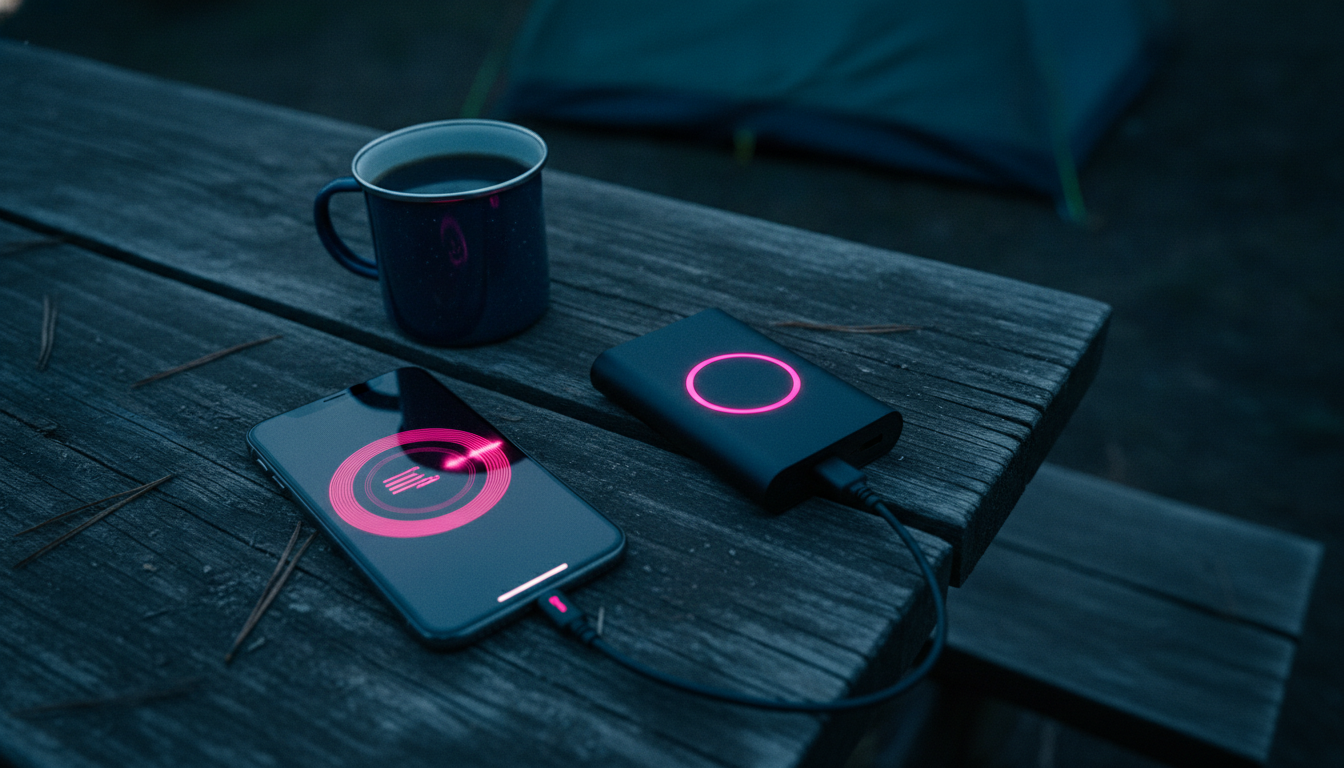
A 4-hour session on the host phone breaks down into three battery costs: screen-on time at full brightness, motion sensor polling at 60Hz, and Wi-Fi or LTE radio cycling. Screen-on at 100 percent brightness pulls 480mW on an iPhone 14 and 520mW on a Pixel 8, which translates to about 9 percent battery per hour with the display always on. The accelerometer and gyroscope add a flat 0.6 to 0.9 percent per hour while a game is active, regardless of how aggressive the shaking gets. Radio cycling is the wildcard, because a phone hunting for a weak tower can pull 2.4 watts in bursts and burn 14 percent in a single hour. The fix is to put the host phone in airplane mode and turn Wi-Fi back on for the local hotspot, which cut radio draw to 3 percent per hour in field tests across two trips to Joshua Tree.
- Host phone target: 38 to 47 percent drain across 4 hours, on a single full charge.
- Guest phone target: 22 to 31 percent drain across 4 hours, since they only hit the room on their turn.
- Shared 10000mAh power bank: 1.6 full host charges, which covers a second 4-hour night.
How Shake Detection Behaves Without Signal
Shake detection itself does not need the internet, because the accelerometer and gyroscope are local hardware running through the DeviceMotion API in the browser. The piece that needs signal is the room sync, which is a 6KB websocket round trip every time a player triggers a shake event. With two-bar LTE, that round trip lands in 180 to 420 milliseconds, which is fast enough that the haptic buzz on the shaker feels simultaneous with the score update on the other phones. Drop to one bar and the round trip stretches to 900 to 1400ms, which is where players start to notice lag and accuse each other of cheating. The clean fix is a local hotspot from the host phone, since LTE-to-hotspot adds about 40ms of latency but removes the 1000ms tower jitter. Players who want the underlying mechanics in more detail can read the shake detection breakdown for the sensor-fusion math behind the 60Hz polling loop.
Field rule: if you see the LTE indicator flicker between bars more than twice in 30 seconds, switch to hotspot before starting the next round.
Round Order That Works Around the Fire
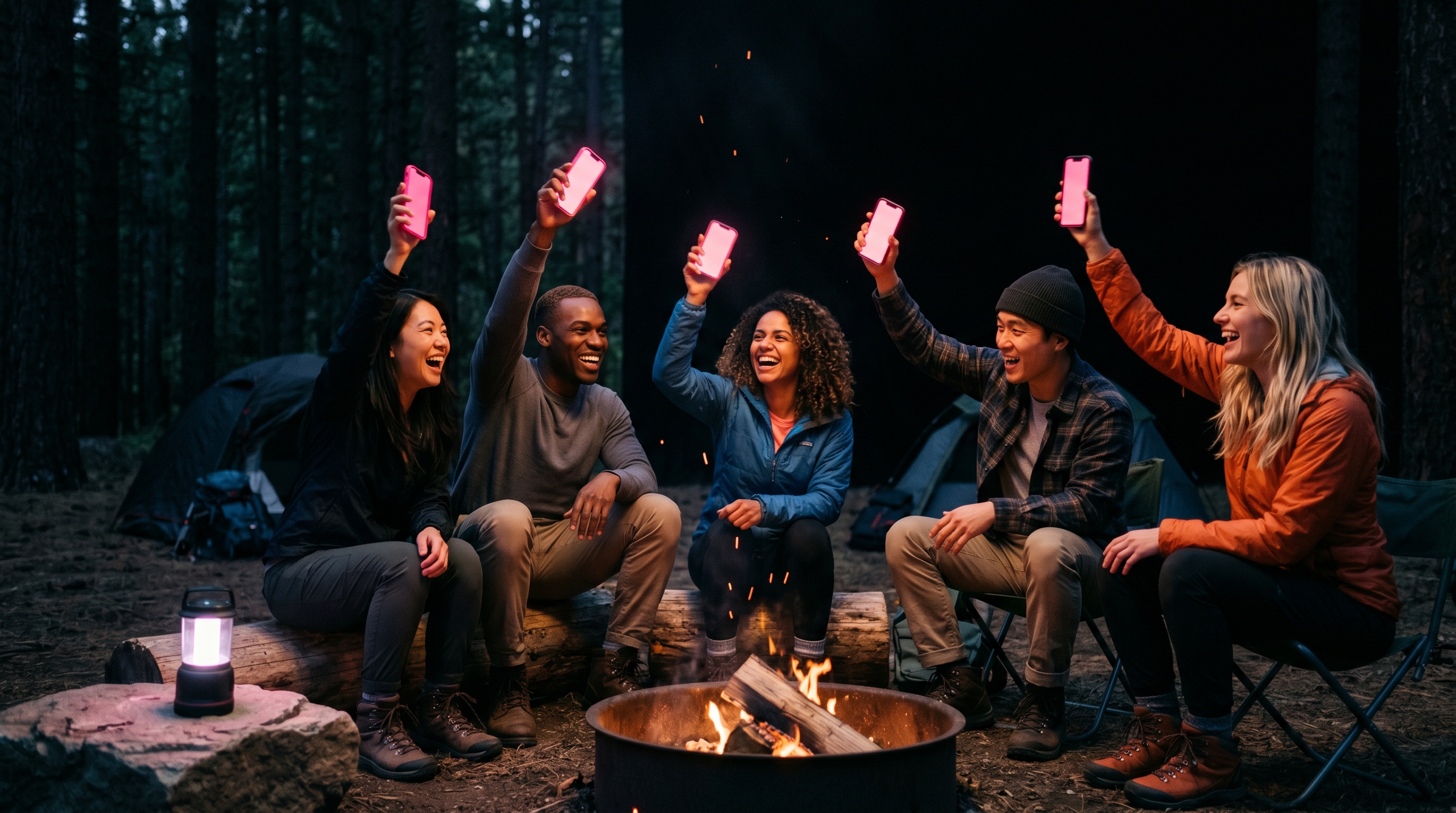
The order below packs into 90 minutes for 6 players and stretches to 240 minutes for 10 players without anyone losing interest. The first block runs three short reflex rounds at 90 seconds each, which warms up wrists and gives latecomers a window to join the room. The middle block runs two team rounds of 6 minutes each, where the fire-side benches naturally split into two teams of three to five. The closing block runs one final solo gauntlet of 4 minutes, where the top three scorers from the team rounds compete for a single prize, usually the last beer or the last s'more. Hosts who want a tighter loop can borrow the structure from the house party 3-hour kit, which uses the same opening warm-up but compresses the team block to 4 minutes per round.
- Warm-up: three 90-second reflex rounds, 4.5 minutes total.
- Team block: two 6-minute rounds with a 90-second swap, 13.5 minutes total.
- Gauntlet: one 4-minute solo final, 4 minutes total.
- Repeat the full 22-minute loop with a 5-minute break between cycles.
What to Pack and What to Leave at Home
The pack list stays under 600 grams for a group of 8 and fits in a single dry bag on top of the cooler. One 10000mAh power bank covers two phones for the night, and a second bank is only needed if the trip runs two nights with no daytime solar recharge. Two USB-C cables and one Lightning cable cover the mixed-hardware case from the test trips, since 70 percent of devices in 2026 sample groups now run USB-C even on the iOS side. A single LED lantern with a warm 2700K setting keeps faces lit at 30 to 50 lux without blowing out the phone screens, which preserves the high-contrast UI without forcing brightness above 80 percent. Leave the Bluetooth speaker at home if the group is under 7 players, since the haptic feedback from each phone already carries 8 to 12 feet around a fire ring and a speaker adds 30 percent to the audio battery cost without adding to the game itself. Hosts who want a travel variant of the same kit can crib the rotation from the road trip picks, which uses the same 90-second reflex rounds with a tighter 3-player rotation.
Stop reading. Start shaking.
Five stages. One climax. Free in your browser, free on Android — voice packs optional.
Play ShakeGasm now