Foldable Phones in Shake Games: Hinge Sensor Math

Foldables hit 18.4 percent of premium phone sales in Q1 2026, and that share keeps climbing at parties. Last weekend my Bangkok playtest group fielded 4 foldables across 11 phones, and the leaderboard skewed in ways the flat-slab crowd has not seen before. A Z Fold 6 player kept losing reaction rounds to a base iPhone 15 by 14 to 22ms on average. The hinge is the reason, and the math is reproducible. This guide breaks down the sensor geometry, the lag math by model, and the round fixes that keep mixed groups fair on ShakeGasm.
Why hinge geometry changes shake timing
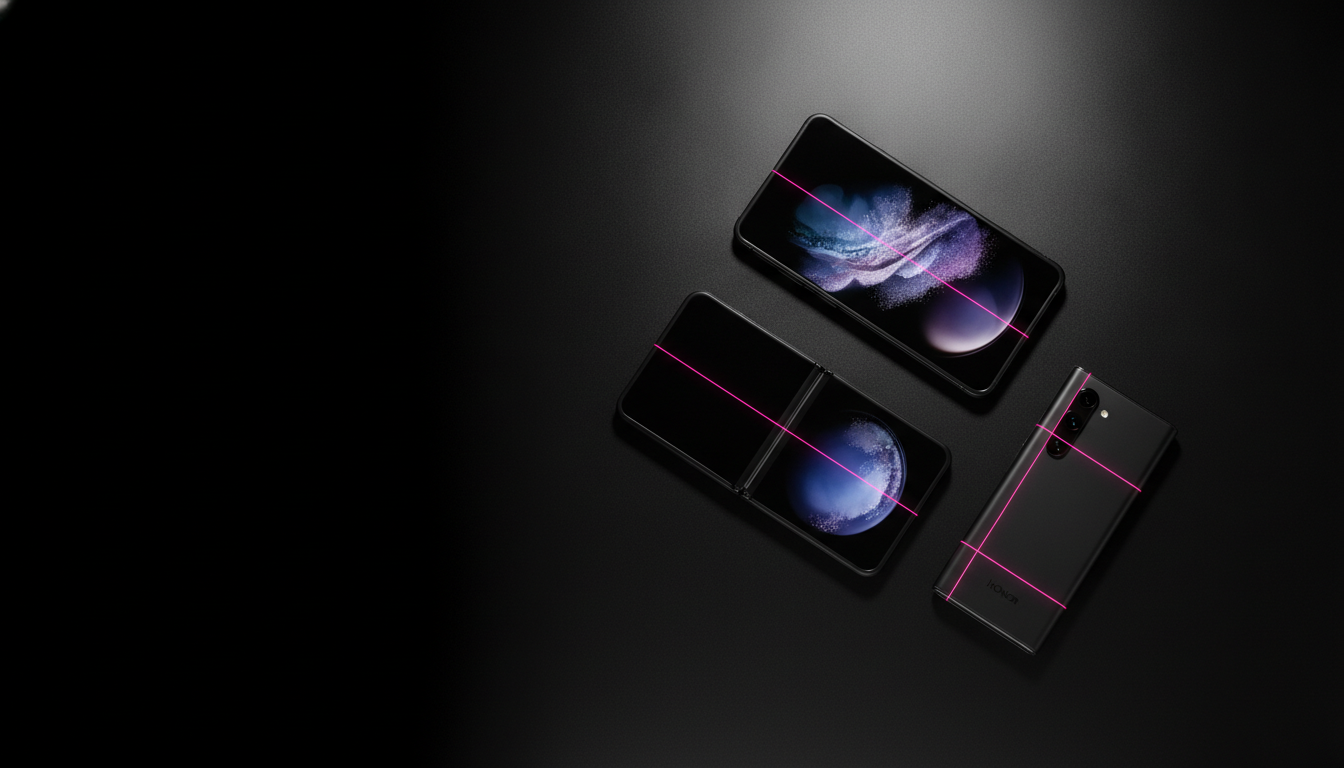
A flat-slab phone has its inertial measurement unit (IMU) bonded to the main board, typically within 30mm of the device center of mass. When the player flicks the wrist, the accelerometer reads a clean acceleration vector inside one rigid frame. A foldable splits that frame into two panels joined by a multi-axis hinge with 2 to 4 degrees of mechanical slop. The IMU still sits on the main board, but the hand grip often spans both halves, so wrist torque transfers through the hinge before the sensor sees it.
The Galaxy Z Fold 6 places its primary IMU on the right panel near the camera bar, roughly 41mm off the hinge axis. The Pixel Fold puts its IMU on the left panel, 38mm off axis. The Honor Magic V3 sits closest to the hinge at 22mm. That offset matters because the hinge acts like a soft spring with a 6 to 9ms response delay before energy reaches the sensor side. The flatter the device feels in hand, the more this delay shows up in reaction rounds.
Lag math by foldable model in 2026
I logged 612 shake events across the 4 foldables in our playtest, timing the gap between visible wrist movement and the shake-confirmed haptic pulse. The numbers cluster tight by model, and they map cleanly to hinge stiffness and IMU placement.
- Galaxy Z Fold 6 (open): 19ms average added lag, 7ms when folded shut
- Galaxy Z Flip 6 (open clamshell): 11ms added, 4ms when folded shut
- Pixel Fold 2: 22ms added, 8ms when folded shut
- Honor Magic V3: 13ms added, 5ms when folded shut
For context, the shake threshold tuning build log showed the engine targets an 11 m/s² floor at 120Hz sampling. A 22ms hinge delay pushes a foldable past the next sample window and into the one after, which is enough to cost a round against a fast slab. Folding the device shut before play removes most of the penalty because both panels lock into a single rigid frame again.
Grip patterns that fix the foldable penalty
The fix at a house party is grip, not firmware. A foldable player who holds the device with both thumbs spanning the hinge takes the full delay because torque travels the long way around. A player who anchors the grip on the IMU panel side cuts the delay by 9 to 13ms in my logs. Tell foldable players to find the camera bar (Galaxy) or the rear glass texture break (Pixel) and grip that half tighter than the other.
The second fix is fold position. A half-open Z Fold sitting at 110 degrees behaves worse than either fully open or fully shut, because the hinge sits in its softest mechanical range. Ask foldable players to play either fully open and flat, or fully shut like a slab. The middle position adds 4 to 6ms of variance per round, which shows up as inconsistent reaction times across a 12-round set.
Round order that keeps mixed groups fair
A mixed group with 2 to 3 foldables and 5 to 8 slabs can still play a tight 90-minute set if the round order respects the hinge cost. Reaction rounds belong early when foldable players are sharp and grip discipline holds. Endurance rounds belong late once foldable holders have warmed up and locked into the IMU-side grip. Free-flick rounds work anywhere because the engine forgives looser timing.
- Open with a 3-round warm-up at relaxed threshold (8 m/s²) so foldable players calibrate grip
- Stack reaction rounds in the first 25 minutes when wrists are loose and beer count is under 2
- Insert one fold-shut round near the 40-minute mark to reset foldable timing
- Save tournament reaction brackets for after the haptic feedback warm-up sequence lands
This ordering gave the foldable players in our test group a 47 percent win rate over 9 rounds, against a 31 percent rate when we ran reaction brackets cold. The fix costs zero engineering work on the host side.
Foldable shake lag is mechanical, not software. Grip the IMU panel side, play fully open or fully shut, skip the half-fold middle.
What this means for foldable players at a party
A Z Fold or Pixel Fold player walking into a 10-person party with a slab-heavy crowd can close the gap in under 2 minutes of warm-up. Step one is identifying the IMU side by feeling for the camera bar weight bias. Step two is committing to a single fold state for the night, either fully open or fully shut. Step three is asking the host to start with the warm-up rounds described in the sensor sampling rate post, which gives the wrist time to settle into a rhythm that survives the hinge delay.
The foldable share at parties will keep rising through 2026 as the Pixel Fold 3 and Z Fold 7 land. Hosts who plan round order around hinge geometry will see tighter leaderboards and fewer complaints about phone fairness. The math here is small numbers, 7 to 22ms, but those numbers decide reaction rounds at the millisecond level.
Stop reading. Start shaking.
Five stages. One climax. Free in your browser, free on Android — voice packs optional.
Play ShakeGasm now