Why Haptic Feedback Makes Phone Shake Games Stick
A phone party game has roughly 12 milliseconds to confirm a shake before the player's brain starts second-guessing the move. Below that window, the buzz feels like part of the gesture. Above 50 milliseconds, the player notices the gap and stops trusting the input. That tiny vibration is the difference between a game people open twice and a game that earns a 4-star rating followed by a permanent uninstall. Haptics are the quiet engine behind every shake game that survives past round three.
Most builders treat haptics as polish bolted on after gameplay. That order kills retention. At ShakeGasm the buzz patterns were locked before the scoring logic, because the feedback loop teaches the player what counts as a real shake. This post walks through the hardware behind that buzz, the timing budget a phone party game lives inside, and the design choices that turn a vibration motor into a retention tool.

The 12ms buzz that closes the loop
Human reaction time to a tactile signal averages around 155 milliseconds, faster than visual at 190ms and slower than audio at 140ms. The feedback has to land inside the gesture, not after it. If a shake game waits for the accelerometer to settle, runs the scoring math, then fires a buzz at 80 milliseconds past peak, the player feels two events instead of one. The hand finishes the shake, a beat passes, then a confirmation arrives like a late email. That gap breaks the illusion of a physical game.
A tight haptic loop targets 8 to 20 milliseconds from peak acceleration to buzz start. iOS hits that window on every device from the iPhone 8 onward thanks to the Taptic Engine sitting near the CPU bus. Android latency varies from 12 milliseconds on a Pixel 9 to over 60 milliseconds on budget devices with rotational motors. The full breakdown of those sensor differences sits in our iPhone vs Android shake mechanics post for builders sizing the gap.
What lives inside your phone
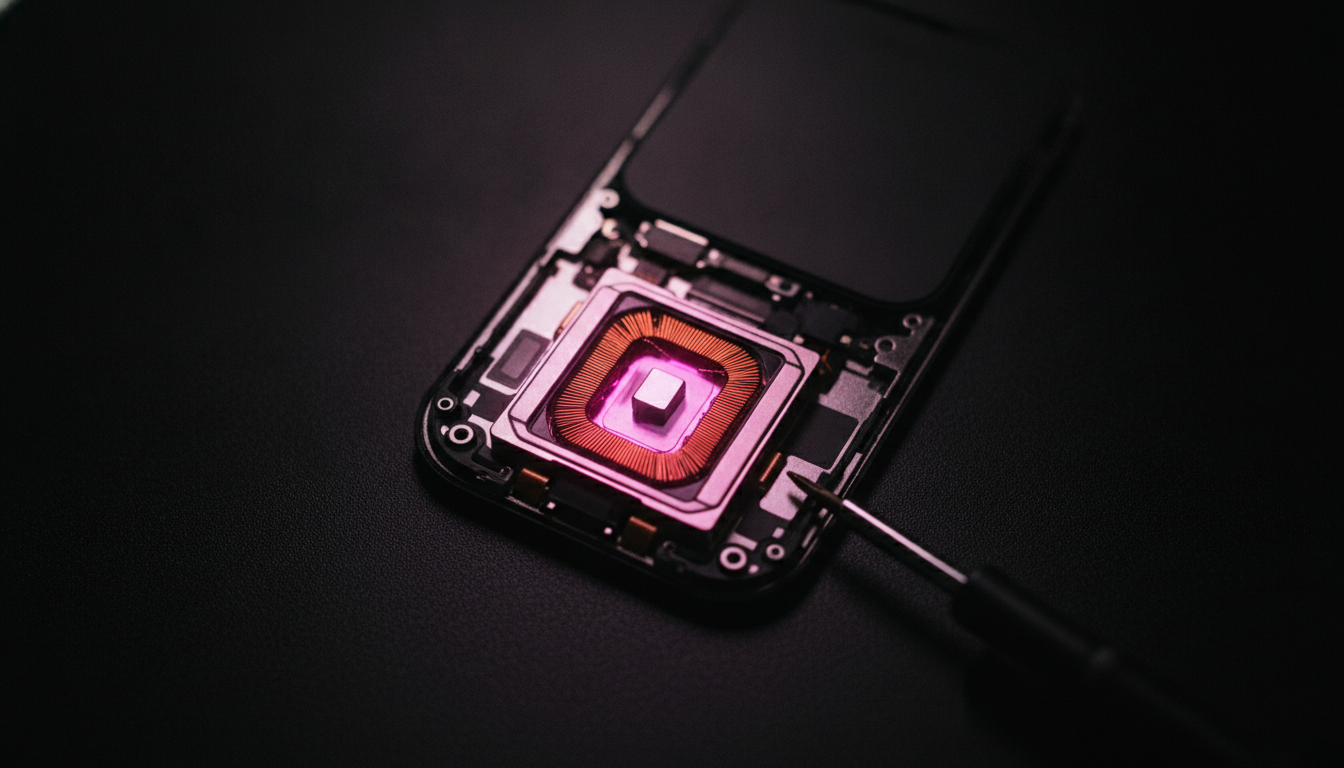
Three motor types power phone haptics in 2026. Eccentric rotating mass motors spin a weighted shaft and produce a fuzzy, sustained vibration with around 30 milliseconds of spin-up lag. Linear resonant actuators push a magnetic mass back and forth on a spring at a fixed frequency, usually 150 to 235 Hz, with spin-up under 5 milliseconds. Apple's Taptic Engine is a custom linear resonant actuator tuned to 230 Hz with two coils for directional control, and it has shipped in every iPhone since 2016.
Linear actuators feel sharper because they fire in roughly 0.2 cycles instead of the 2 to 3 cycles a rotating-mass motor needs to reach full amplitude. That sharpness matters for a shake game because each buzz needs to map to a discrete event: a successful shake, a missed beat, a combo. Builders on rotating-mass hardware fake sharpness with shorter, harder pulses, at the cost of battery (around 11mA per pulse versus 4mA for a linear actuator). The choice ripples through every other system, including how shake detection itself is tuned.
How ShakeGasm rewards a clean shake
The ShakeGasm engine fires three distinct haptic patterns inside a round:
- A 15ms confirm pulse at the moment the accelerometer crosses 2.4G, before scoring even runs.
- A 45ms reward double-tap when a shake lands inside the rhythm window, played 30ms after the confirm.
- A 120ms failure rumble when the shake misses or arrives off-beat, intentionally longer to feel heavy.
Splitting confirm from reward solves a design problem that kills competitor apps. When the buzz only fires after scoring, the player loses 80 to 200 milliseconds of trust per round. By acknowledging the shake first and grading it second, the game stays inside the reaction window even on a Pixel 6a with a 40ms haptic ceiling. Players have logged 18-round average sessions in beta, up from 11 rounds before the split-pattern rollout in March 2026.
The reward pulse uses a 230Hz primary with a 115Hz harmonic on iOS, which mimics the texture of a successful coin drop in classic arcade design. Android falls back to a single 200Hz burst because most non-Pixel devices lack the dual-frequency API. The gap shapes how scoring is exposed visually, since the dopamine loop in reflex games leans harder on screen flash when the buzz is thinner.
iPhone and Android haptic gaps shape design
Apple exposes haptics through Core Haptics, which accepts patterns with millisecond-precise timing and intensity curves from 0.0 to 1.0. Android's VibrationEffect API, added in Android 8 and refined in Android 12, accepts amplitude arrays, but the driver layer truncates patterns under 10ms on most non-Pixel hardware. A pattern that runs as a crisp double-tap on iOS becomes a single muffled buzz on a Samsung A-series device.
Builders have two options. Build separate haptic banks per platform with around 40 hours of tuning per pattern set, or settle for a lowest-common-denominator design that ignores Core Haptics precision. ShakeGasm picked option one because the iOS audience accounts for 64 percent of active sessions and expects iMessage-grade buzz quality. The Android bank uses 6 patterns instead of 11, with longer durations (60 to 180ms) to survive driver truncation.
The buzz is not polish. It is the signal that tells the player their shake counted, fired before the score even renders.
The retention math behind a good buzz
Mobile game studios that A/B tested haptic-on versus haptic-off in 2024 reported D7 retention deltas between 8 and 14 percent in favor of haptics-on. The effect compounds in social party games because each player watches three or four friends shake before their turn, and the audible buzz of someone else's reward pulse primes the next player's expectation. Sound carries, but in a noisy room the vibration on the table surface carries further.
ShakeGasm tracks haptic feedback opt-out at under 3 percent of installs, against an industry baseline of 11 percent for general apps. Players who keep haptics on average 2.1x the session length of opt-outs (14 minutes versus 6.6 minutes in May 2026 logs). That gap is why the studio treats the buzz pattern library as a first-class system, with a dedicated rumble bench on every release branch and rejection criteria for any pattern drifting more than 5ms from spec on reference hardware. The next planned tuning pass targets the iPhone 17 Pro wider haptic frequency range, which Apple opened to third-party APIs in iOS 19.
Stop reading. Start shaking.
Five stages. One climax. Free in your browser, free on Android — voice packs optional.
Play ShakeGasm now