How to Host a Trivia Night at Home
A good trivia night at home runs on three numbers: 45 questions, 4 teams, and 90 seconds per answer. Miss any of those and the room drifts within forty minutes. Host 20 adults with the wrong pool depth and you burn through content before dessert. Host 6 adults with 60 questions and you kill the pace by round four. The job of the host is pool math, timing math, and scoring math, in that order.

Set the format before guests arrive
The format decision happens 48 hours before the party, not 10 minutes before guests arrive. Pick team size first because every other number scales from it. Four teams of three is the sweet spot for an 8 to 12 person group because it keeps each answerer accountable without starving anyone of a turn. Pairs feel sparse, teams of five hide freeloaders, and solo play kills the social load that makes trivia land at parties. Lock the team size and the number of rounds together: four teams and five rounds gives you 20 team-answers, roughly 50 minutes of play. That slot fits a dinner party window between courses or a bar-style evening before the group splinters. Write the format on a card and tape it to the fridge, because the host forgets around round three. For a longer plan on hosting the full night around the trivia block, see our house-party host playbook.
Build the question pool so the pace holds
Question count is the single biggest reason a home trivia night stalls. Build 45 questions for a 60-minute window: 36 played, 9 reserved for ties and misfires. Mix five categories at nine questions each, laddered inside each category with three easy, three medium, three hard, in that order, so round one feels generous and round five rewards the sharp team. Avoid questions whose answer requires more than seven syllables to say out loud, because the energy dies while people write. If you need a tested starter pool, our pack of 50 trivia questions with answers covers the ladder cleanly, and a short reflex deck on ShakeGasm works as a palate cleanser between rounds.
- Pop culture: film, TV, celebrity names from the last 15 years.
- Music: artists, lyrics, release years from 1980 forward.
- Geography: capitals, borders, flags, and one weather question.
- Food and drink: cocktails, cuisine origins, one spice question.
- Host wildcard: inside references, local sports, or a chosen decade.
Reserve 20 percent of your pool for ties and bad questions. Nothing kills a trivia night faster than running out of material at round four with two teams knotted at 24 points.
Run the room: pacing, scoring, interruptions
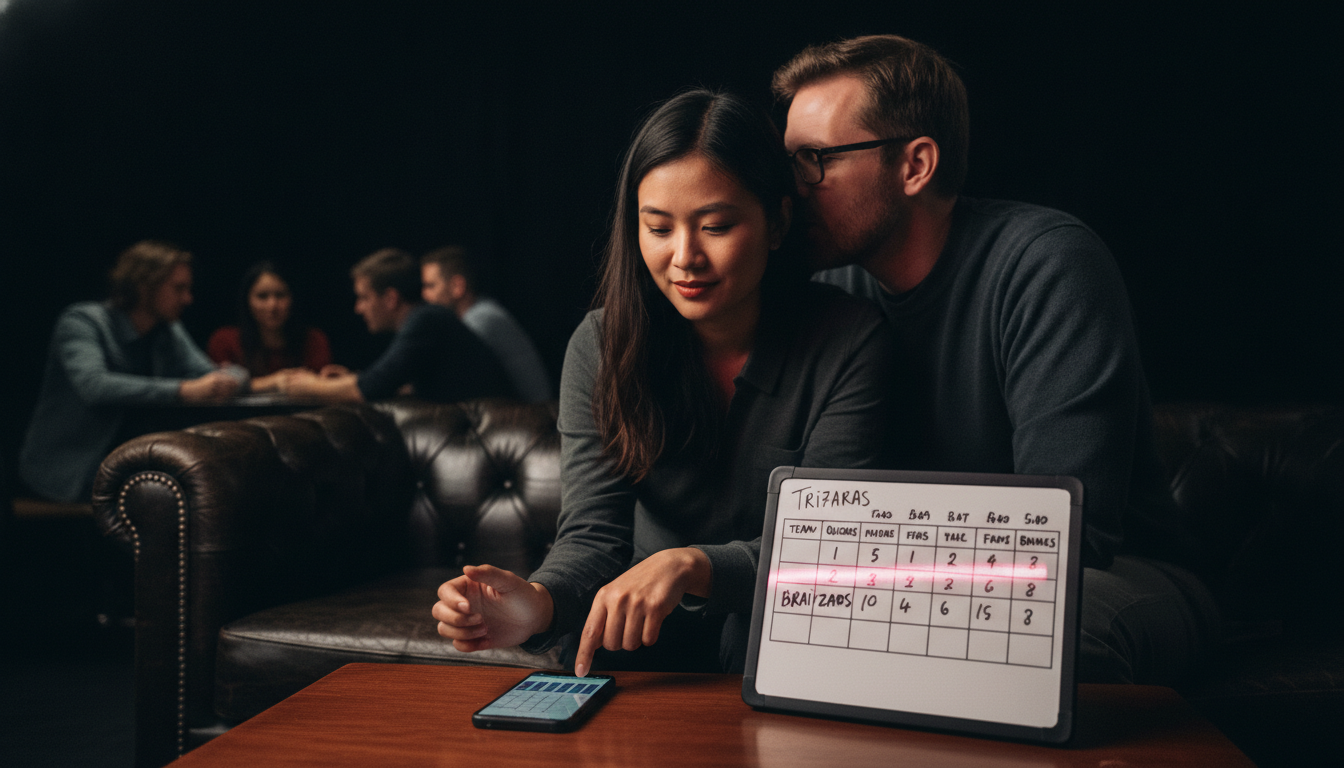
Pacing lives inside each round. Read every question twice at a slow cadence, then start a 90-second timer that every team can see. A kitchen timer on the counter beats a phone timer because glances at the counter feel neutral and glances at a host phone feel like cheating. Collect written answers on index cards or let teams tap answers into a phone if your setup supports it. Score each round out loud and write the running total on a visible whiteboard so no team argues with the ledger. For the first 20 minutes, keep questions tight; after that, allow one 30-second detour per round for a side-answer or anecdote. Interruptions cost 90 seconds each when they land well and six minutes when they do not, so cap them at two per hour.
Fix the dead moments between rounds
The dead moment is the four minutes between rounds where guests check phones and the energy sags. Fill it with a 30-second physical reset: everyone stands, swaps one chair, and refills a glass. Movement breaks the cognitive load and resets the body clock. Keep a side format running in parallel for the 10 percent of guests who tune out, like a question jar on the counter with icebreaker prompts or a 90-second phone reflex round on ShakeGasm that deploys without a reset. On an evening longer than 90 minutes, swap the mode entirely for the back half; running trivia the full four hours flattens the room by round seven. For reflex-based options to rotate in, our phone party games roundup ranks 12 formats by setup time.
Scoring systems that stop fights
Three scoring systems work at home: flat, laddered, and wager. Flat gives 1 point per correct answer and is the lowest-friction system for groups under 12. Laddered gives 1, 2, or 3 points based on question difficulty and is the right system for mixed-skill rooms because it rewards range. Wager scoring lets teams double a round stake once per night and is where upset wins happen in the fifth round. Pick one before the first question and announce it on the card by the fridge, because switching mid-night costs trust. Write every team score after every question, never after every round; delayed ledgers get challenged twice as often. If a team disputes an answer, the host overrules by reading the source out loud within 20 seconds; longer debates kill the next three minutes of play.
What to skip on your first night
First-time hosts over-engineer the night and under-engineer the room. Skip custom buzzer hardware for your first run, because the setup eats 25 minutes and the buzzers break twice a party. Skip prize structures larger than 20 dollars, because big prizes shift the energy from laughter to lawyering. Skip trivia written entirely by a single person; crowd-source three of the five rounds from guests two days before the party so you get category range for free. Skip any question whose answer requires a Google check, because that eight-second lookup breaks the round for everyone. The simplest first night is five rounds, four teams, 90 seconds per answer, flat scoring, no prize, two reset breaks. The second night, add laddered scoring and a wager round. By the fourth party, you can run buzzers, prize ladders, and themed decks without the room drifting.
Stop reading. Start shaking.
Five stages. One climax. Free in your browser, free on Android — voice packs optional.
Play ShakeGasm now