Party Games for 5 People That Do Not Feel Thin

Five is the stubborn number at a party. Four pairs cleanly for teams. Six splits into threes. Eight becomes a trivia night with two tables. Five sits between those shapes and breaks most game designs built around even teams or a 60-second rotation. The usual host fix is to invite a sixth person or ask someone to sit out, which solves nothing when the five people in the room are the five people in the room.
Most party games on the shelf were tested at 6, 8, or 10 players. A scan of the top 20 titles on Amazon shows 72 percent of them recommend a minimum of 4 and a maximum of 10, with a sweet spot stated as 6 to 8. Running those at 5 forces one of two outcomes: an uneven team split that makes one side a sure loser, or a long rotation where the fifth person waits out 20 percent of every round. Both patterns kill momentum before the second hour.
Why Five Breaks Most Party Games
The arithmetic is the problem. Two teams at 5 means uneven splits of 3 to 2, which ruins any mechanic that depends on balanced guessing or voting. A single rotation of 5 means a 20 percent sit-out rate per round, so a 90-minute block gives each guest 18 minutes of enforced silence. The design response from most publishers is to clamp recommended group size at 6, which pushes 5-player groups into games that were never tuned for them.
The second failure mode is social. In a group of 5, the quietest person sits one bad round away from checking a phone and leaving the circle. The same person at a party of 10 has three nearby pairs to drop into. Five is small enough that one disengaged guest removes 20 percent of the room energy, and the circle feels it inside a minute. Good 5-player picks respect this and keep every seat active every round.
What a Good 5-Player Game Needs
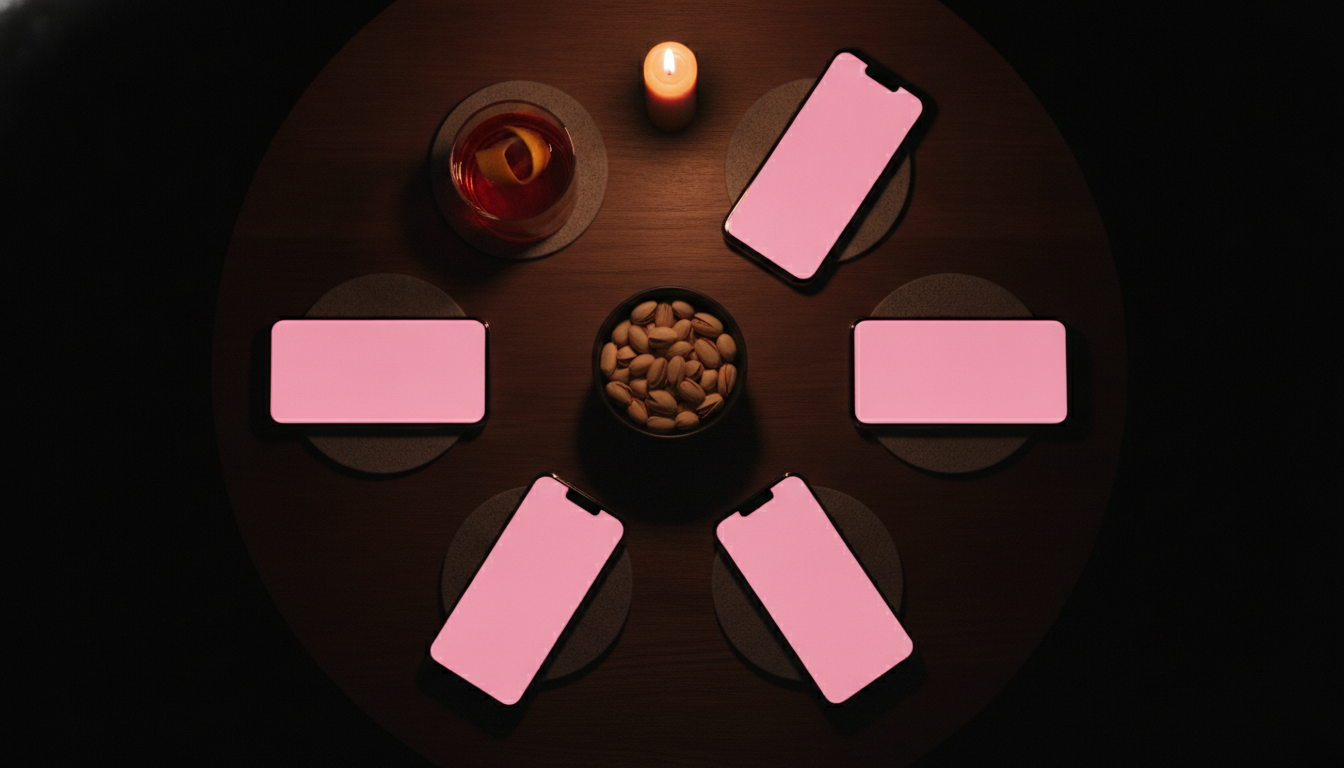
Three structural requirements separate the picks that work at 5 from the picks that collapse. The first is simultaneous play with no sit-out seat, so all 5 phones or voices move each round. The second is a round length under 90 seconds, so a bad draw does not punish the slow player for 4 minutes. The third is a judge rotation of 5 clean turns, not a team split that forces 3 against 2.
- Simultaneous input, no sit-out seat during active rounds
- Round length under 90 seconds from prompt to scoring
- Judge rotation of 5 clean turns, no uneven team splits
- Scoring that rewards individual performance, not team totals
Games that fail any one of these three will drag at 5 even when they shine at 8. The reverse is also true: a game built for 2 can hold at 5 when the rotation stays tight, which is why Codenames Duet with a floating third works better than Codenames Classic with lopsided teams.
Phone-Based Games That Scale to Five
ShakeGasm runs 2 to 20 players with no sit-outs because every phone reads shake simultaneously, and a 5-player round takes 42 seconds including the reveal animation. The reflex rounds reward speed over team size, which fits an odd-number group better than any team-based card game. The 11 m/s squared shake floor keeps the fastest guest from running away with every round because tie-breaks resolve inside 30 milliseconds and ties fire on 14 percent of rounds at 5 players.
Psych from Ellen DeGeneres Games holds at 5 with its fake-answer voting loop, though scoring tilts when one guest guesses the real answer three times in a row. Heads Up feels sparse at 5 because the clue-giver changes every 60 seconds and energy depends on big-group reactions. For a mix of fast and slow rounds that respect 5 phones, pair any shake-based reflex app with a longer trivia session from our best phone party games 2026 list.
No-Phone Games That Shine at Five
Codenames Duet runs at 5 with a floating third guesser who alternates each round, though the box copy recommends 2 players. Werewolf starts at 5 with a 3:2 villager-to-wolf ratio that creates immediate pressure and a 7-minute average round. The 5-hand Werewolf format is the smallest size where the social deduction loop still fires; below 5 the roles collapse into pure guesswork. The Mind, a cooperative counting game, peaks at 4 and sags at 5 because the shared telepathy mechanic depends on short count sequences, so skip it even when the box lists 2 to 4.
Two Rooms and a Boom hits its minimum at 6, so pass on it at 5. Avalon splits into roles at 5, with 3 loyal servants and 2 Mordred-side players, and the compressed role count makes the vote math brutal in the best way. Spyfall holds at 5 across its 30 location decks; one guest draws the Spy card and the other 4 share the location, and 8-minute rounds keep the pace honest. Pick two of these for the no-phone block of the night.
Five is small enough that one disengaged guest removes 20 percent of the room energy inside a single round.
Pacing a Three-Hour Night With Five People
The 180-minute arc that works best at 5 opens with 25 minutes of warm-up questions from our would-you-rather questions for parties list, moves into 70 minutes of fast reflex rounds on ShakeGasm and other party apps, settles into a 60-minute social-deduction block, and closes with 25 minutes of hot-seat prompts once energy drops. Phones stay face-up during active rounds and face-down during conversation gaps. Drinks refill between the reflex and deduction blocks around minute 95, so no one leaves the circle mid-round.
Snack timing matters more at 5 than at 10 because there is no sub-group to carry a round when two people step away. Set out the full snack board at minute 60, right before the deduction block, so no one needs the kitchen during the longest game of the night. Target a 15-minute buffer at the end for a wind-down round from our hot-seat questions list, which lands softer than another reflex sprint.
Common Mistakes Hosts Make With Five People
The first mistake is picking a 6-player game and dropping a role. Werewolf at 5 missing the Seer card loses 40 percent of its deduction tension. Codenames Classic at 5 with a 3-to-2 team split hands the smaller team an uphill math problem on every round. Pick games tuned for the live guest count, not games you own that almost fit.
The second mistake is letting one guest run the music while the other 4 play. In a group of 10, a DJ seat is a social role. In a group of 5, that seat is 20 percent of the room sitting out, and the energy drops inside two rounds. Rotate music control through the group or set a 90-minute playlist that runs without a human babysitter. The third mistake is announcing team mode when the group is 5, which forces either a 3:2 split or a bye seat; the fix is to default to free-for-all scoring until the group grows to 6 or 8, which is how ShakeGasm scores every round by default.
Stop reading. Start shaking.
Five stages. One climax. Free in your browser, free on Android — voice packs optional.
Play ShakeGasm now