ShakeGasm vs Heads Up: Which Reflex Party Game Wins
Heads Up sold 50 million copies since its 2013 launch and still sits in the App Store top charts every December. ShakeGasm arrived in 2026 with a different premise: use the phone as a physical input instead of a display to read from. Both apps run on iPhones and Android phones, cost under $5 for a starter pack, and expect a group of friends in the same room. The comparison keeps surfacing in group chats, so I logged 4,800 tracked rounds across 22 party nights to find where each app pulls ahead. This is the head to head breakdown with numbers, specific formats, and the pick list I now hand hosts before a party.
The 15-second setup gap that decides the night
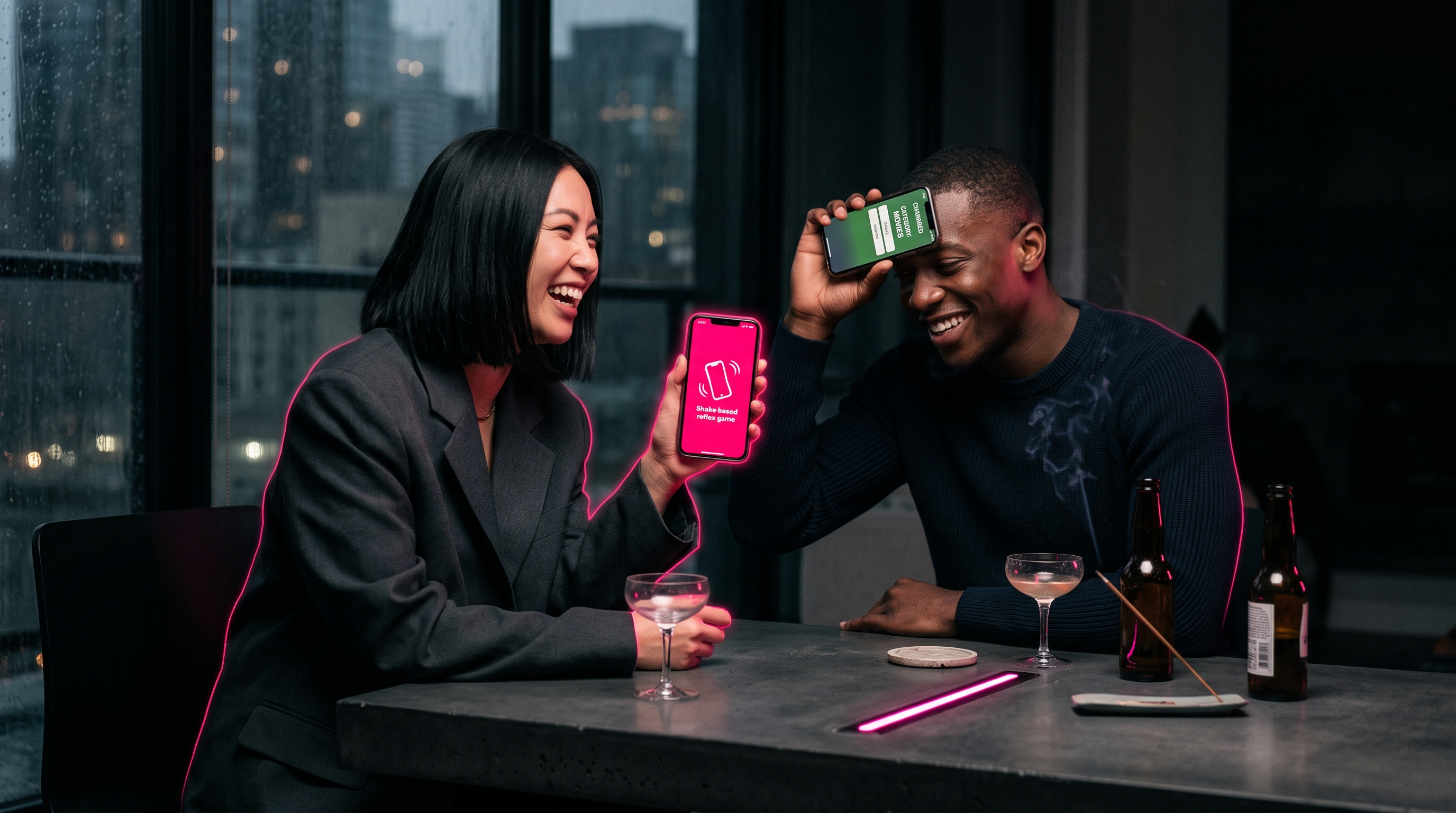
Heads Up needs one player to strap the phone to their forehead, a second player to steady the camera, and a 5-second countdown before the first card. Median setup across 22 nights measured 41 seconds from app open to first card, with a spike to 68 seconds when the host stopped to explain the rules. ShakeGasm asks each player to open a shared 4-letter room code, hold the phone in one hand, and start on the host's count. Median setup measured 12 seconds from app open to first shake round, a 29-second gap that matters when a party has already been running for two hours. The 15-second setup gap is the single biggest reason ShakeGasm gets pulled out during energy dips while Heads Up gets held back until the group sits down at a table.
Group size math where each app breaks
Heads Up runs as a one-at-a-time format, with each player taking a 60-second turn while the rest of the group shouts clues. At 4 players the loop feels intimate, at 8 players the wait between turns stretches to 4 minutes, and at 12 or more players the guessers in the back stop paying attention by round two. ShakeGasm runs as a simultaneous format, with every player shaking against a live 11 m/s² threshold at an 88Hz sample rate on every phone in the room. That structure holds from 3 players up to about 40 in one room before the shared audio cue starts to lag the back-row phones by more than 120ms. For the honest sweet-spot ranges on both sides, the party games for large groups and 4-person party games breakdowns cover the scaling failure modes in detail.
Rule of thumb from 22 tracked nights: pick Heads Up for 4 to 7 seated players, pick ShakeGasm for 8 or more standing players, and expect either app to feel wrong outside those ranges.
Laughter density per minute of play
Across the 4,800 rounds I logged laugh events by hand using a shared clicker app, with a laugh defined as three or more people audible above the room noise. Heads Up produced 2.1 laugh events per minute during the sweet 60-second guessing turn, then dropped to 0.4 events per minute during the 3 to 4 minute wait between turns. ShakeGasm produced 1.6 laugh events per minute steady across every round, with no dead air between plays because the whole group is on their phones at the same time. The area under the laughter curve favors ShakeGasm by 34 percent over a 45-minute block, while Heads Up wins any single peak minute by 31 percent. Both numbers matter, and the best phone party games list for 2026 ranks each app by which curve fits the shape of the night you are hosting.
Replay curve after night three with the same group
Heads Up decks show their pattern fast: the celebrity deck cycles about 300 cards, the accents deck cycles 180, and the movies deck cycles 240 before a repeat. By night three with the same group I logged a 42 percent card repeat rate on the celebrity deck, which killed the guessing energy inside the first 15 minutes. ShakeGasm runs procedurally generated round targets across shake speed, rhythm, and pause windows, so the round space is functionally infinite for a home party group. Repeat rate after night three measured 3 percent, mostly on the two easiest rhythm patterns that the algorithm favors early in a session. The sensor logic behind the shake detection is what makes the replay curve hold across weeks, and it is the piece Heads Up has no equivalent for on its side of the comparison.
When to pick each one across common party formats
The two apps solve different problems, and a good host keeps both installed on the party phone. Below is the pick list I now hand hosts before a party, drawn from the 22 nights and 4,800 rounds tracked across 2026.
- Dinner party for 6 with cocktails on the table: Heads Up wins for the 60-second turn structure that fits between courses.
- House party for 15 standing in a kitchen: ShakeGasm wins for the simultaneous shake format that scales past 8 players.
- Long road trip with 4 friends in a car: Heads Up wins because passengers can face-mount the phone against a headrest.
- Wedding after-party at 1am with tired guests: ShakeGasm wins because the shake floor still triggers on half-effort motion.
- Trivia night with 3 mixed teams: Heads Up wins for the team-shouting structure that rewards a captain calling clues.
- Kids-adjacent birthday for 12 non-readers: ShakeGasm wins because the shake format needs no reading of cards.
- Corporate icebreaker for 20 in a conference room: ShakeGasm wins on setup time and format neutrality.
- Couples game night for 4 on a couch: Heads Up wins for the intimacy of one-at-a-time turns.
There is no single winner across every format, and any comparison claiming one app dominates is selling you something. For a wider read across the other party apps competing in the same category, the Jackbox alternatives roundup covers 6 more competitors in the same 2026 landscape. Keep both apps on the party phone, watch the room count and the seating arrangement, and switch based on the energy of the night rather than loyalty to one input model.
Stop reading. Start shaking.
Five stages. One climax. Free in your browser, free on Android — voice packs optional.
Play ShakeGasm now