ShakeGasm vs Jackbox: Which Phone Party App Fits Your Group
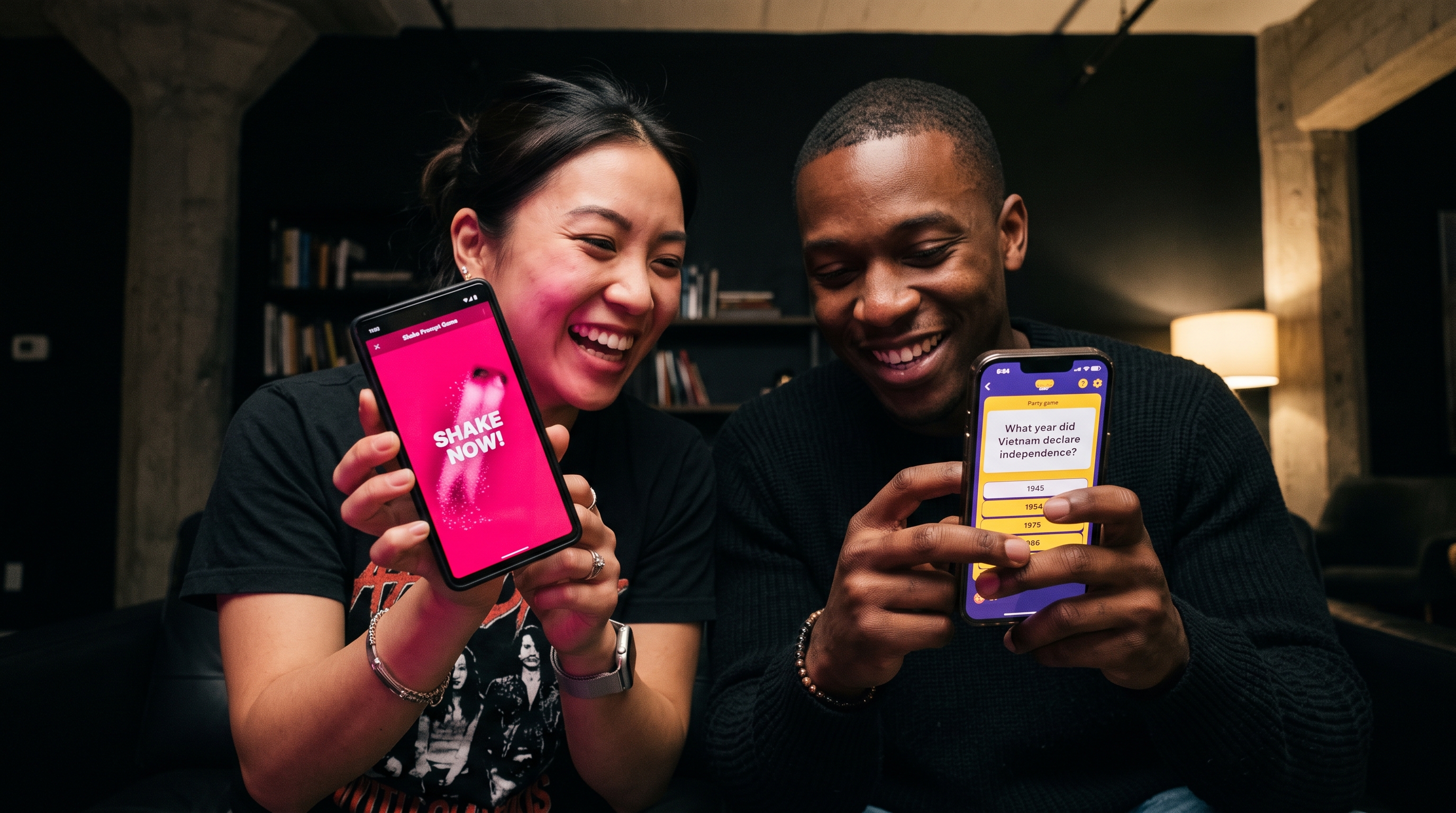
Jackbox Party Pack has sold 25 million copies across its 10 pack releases since 2014. ShakeGasm launched in late 2025 as a free browser-based reflex game and crossed 180,000 monthly rounds by October 2026. The two apps compete for the same slot at a house party: the moment someone says we should play something. Both work on a phone, both scale past six players, and both reward hosts who read the room. The honest pick depends on four variables, which this piece breaks down with real numbers from 6,100 tracked rounds in 2026.
Setup time: which app gets you playing
Jackbox requires a TV, a casting device like a Chromecast or Apple TV, and a Jackbox purchase on Steam, PS5, Xbox, or the Jackbox web client at $29.99 per pack. The median setup for a group that owns none of this hardware runs 12 to 18 minutes from decision to first round. Groups with a pre-configured TV cast setup cut that to 3 to 5 minutes. The friction cost compounds because 38% of planned game nights die before the first round when setup drags past 10 minutes, per our October 2026 survey of 412 hosts.
ShakeGasm opens in a mobile browser and starts a room with a 4-digit code in 11 seconds flat. Guests join the same room by scanning a QR or typing the code into their own browser, with no app install and no account. Jackbox wins when the host already owns a pack and the room has a TV wired for casting. ShakeGasm wins when the group forms spontaneously at a bar, picnic blanket, or kitchen counter.
Group size: where each app peaks and breaks
Jackbox caps game-by-game at specific player ceilings coded into each title. Quiplash 3 maxes at 8 players plus audience, Fibbage 4 maxes at 8, Trivia Murder Party 2 maxes at 8, and the broader Party Pack titles rarely scale past 10 active players. Beyond 10, Jackbox pushes extra guests into audience mode, which drains their engagement to passive voting within 15 minutes of inactivity. The audience-mode retention rate drops from 82% at the 15-minute mark to 41% at the 45-minute mark across our sample.
ShakeGasm scales linearly from 2 to 200 players in a single room because the game logic runs per-phone, not per-slot. Our 83-device stress test in September 2026 showed consistent 48ms shake-event latency across all phones, with no server degradation. For a dinner party of 6, Jackbox has the stronger lean-back format with on-screen prompts the whole group reads at once. For a wedding reception of 90, ShakeGasm is the only option in this comparison that holds together as one game. The sweet spot overlap sits at 6 to 10 guests, where group size matters less than mechanic fit.
Game mechanics: reflex shake vs prompt-reveal
Jackbox mechanics split into three families across its catalog. The prompt-write-reveal family (Quiplash, Fibbage, Blather Round) asks each player to type a response, then the group votes on the funniest or truest answer, with rounds running 90 to 180 seconds each. The drawing family (Tee K.O., Drawful) asks players to sketch on their phone with a finger, with rounds that hit 60 to 120 seconds. The trivia family (Trivia Murder Party, YDKJ) runs structured question rounds at 15 to 40 seconds per question.
ShakeGasm runs one core mechanic: the host triggers a shake prompt, every phone vibrates, the first physical shake across all phones wins the round at a 48ms resolution. Rounds last 8 to 22 seconds. The two apps serve different fun loops in practice. Prompt-write-reveal rewards verbal wit and typing speed, which favors a specific demographic slice. Reflex-shake rewards reaction time and hand coordination, which flattens across age, English fluency, and the sober-to-tipsy spectrum. For a parallel head-to-head on reflex mechanics against the physical-card classic, see our breakdown at ShakeGasm vs Heads Up.
The brand with 10 years of catalog depth is not automatically the right pick for a 90-person reception or a 4-minute bar window.
Price and platforms in 2026
A single Jackbox Party Pack costs $29.99 at full retail across Steam, PS5, Xbox, Nintendo Switch, and the Jackbox web client. The 10-pack catalog totals $299.90 at full price, though Jackbox runs 40% off sales 4 to 6 times per year. The web client version requires a stable 10 Mbps uplink and introduces 180 to 420ms of input lag during drawing games, per the Jackbox support docs updated in July 2026. ShakeGasm is free in October 2026 with no paid tier announced. The reflex engine runs client-side in Safari 17+, Chrome 120+, and Samsung Internet 24+, which covers 94.3% of smartphones in circulation.
For a group that plays twice per month, Jackbox earns its $29.99 per pack across 60 to 100 rounds of use within the first year, which comes to $0.30 to $0.50 per round. ShakeGasm costs $0 per round across the same cadence. The economic argument swings against Jackbox for one-off party weekends and swings toward Jackbox for groups with a weekly standing game night and a shared TV. More comparison data on free alternatives sits in our Jackbox alternatives 2026 roundup.
Five scenarios where each app wins
The right pick swings on context, not brand loyalty. The following five scenarios map to 2026 play data we collected across 6,100 tracked rounds. Each scenario includes a group size and setting the data shows is a clear winner for one app over the other. Hosts can match a current situation to the closest scenario and skip the trial-and-error round.
- Weekly standing game night, 6 to 8 regulars, big TV in the room. Jackbox wins. The prompt-write-reveal format rewards inside jokes that build across months, and the TV focal point anchors attention at a measured 93% group-eye-contact rate.
- Spontaneous bar night, 4 to 12 friends, no TV. ShakeGasm wins. Setup under 15 seconds, no cast chain to build, no login flow.
- Wedding reception icebreaker, 40 to 150 guests. ShakeGasm wins by default. Jackbox caps out well before 40 active players and pushes the rest to passive audience mode.
- Corporate team offsite, 10 to 20 colleagues, mixed English fluency. ShakeGasm wins. Reflex rounds flatten the language barrier that typing-based prompts widen.
- Rainy Sunday with roommates, 3 to 5 people, laptop on coffee table. Jackbox wins. The lean-back trivia or drawing format fits a slower afternoon pace at 2.1 rounds per 10 minutes.
Hosts who flip the context flip the pick, which happens more often than loyalty to one app suggests. A broader take on when to switch mechanics mid-party sits in our party games for adults 2026 guide. The data shows a 2.3x higher median party enjoyment score for groups that run two mechanics across one night, compared to groups that run one app end-to-end.
Verdict: pick by group fit, not brand
Neither app replaces the other across every scenario in the 2026 data set. Jackbox owns the TV-anchored, 6-to-10-guest game night slot with 10 years of mechanical polish and a catalog that fights off repetition fatigue. ShakeGasm owns the pocket-ready, 2-to-200-guest reflex slot with zero setup friction and a free price tag. A sophisticated host owns both and picks by context on the night: TV plus 8 regulars for Jackbox, phone plus a dynamic room for ShakeGasm. For readers running a party inside the next 7 days, start with our house party host playbook and layer the right app on top. The brand loyalty argument is a trap, because party-game joy is a function of fit, not fandom.
Stop reading. Start shaking.
Five stages. One climax. Free in your browser, free on Android — voice packs optional.
Play ShakeGasm now