Codenames Alternatives for Adult Parties 2026
Codenames sold 3.2 million copies between 2015 and 2024, and it still owns the 5 to 8 player word-association slot on most game shelves. The math starts to break at 10 guests, at 2 AM, and at any party where two of the four guests have never played before. This guide ranks seven alternatives that hold up in the exact rooms where Codenames stalls, with setup times, group-size floors, and honest notes on where each one falls short.

Where Codenames Falls Short at Adult Parties
Codenames wants two teams of 3 or 4 with one confident spymaster on each side. That structure creates three failure modes I see on repeat. First, the spymaster load: one person carries 70 percent of the cognitive work and stops laughing by round 3. Second, the drift problem: a single 25-word grid takes 8 to 14 minutes when guessers debate every clue, and drunk parties debate every clue. Third, the onboarding tax: teaching a new player during a live round adds roughly 4 minutes of dead air, and new players sit out the first two rounds while they read the rulebook.
The box also punishes room shape. A 90cm square coffee table fits the grid at 5 players. At 9 players two guests are craning from behind the couch, and one is reading numbers upside down. Party hosts who track this stuff (a group of us has logged 41 sessions across the last 18 months) see engagement drop after minute 42 of any single Codenames session, which is right when a good party is meant to accelerate. Our breakdown of party games for 6 to 8 people shows where the drop-off hits in similar formats.
What to Look For in a Codenames Replacement
A solid alternative solves at least two of the three failure modes above. The four traits that matter for adult groups in 2026 are:
- Setup under 90 seconds from box or app open to first turn taken.
- No fixed spymaster role, or a rotating one that resets every 3 minutes.
- Rounds shorter than 4 minutes, so any newcomer sits out for one round and never two.
- Scales cleanly from 4 to 12 without adding a second board or splitting the room.
You lose the elegant clue-word geometry of Codenames when you go this direction. You gain the ability to keep 11 people in the game past midnight, which is the harder trick. For a ranked take on formats that pass all four tests, our roundup of the best party games for adults in 2026 covers 20 options with the same criteria applied.
Seven Codenames Alternatives Ranked by Group Size
Rankings below use one number per game: the group size where the format peaks based on our 41 tracked sessions, plus the observed setup time in seconds. Prices are US MSRP as of September 2026.
- Poetry for Neanderthals (peak 5 to 7, setup 55 seconds, $19.99). One-syllable-only clue-giving with a NO stick as penalty. Solves the spymaster load because everyone gives clues on rotation. Falls flat above 8 players when the stick-passing gets slow.
- Decrypto (peak 6 to 8, setup 3 minutes, $24.95). A stealth cousin of Codenames with harder rules but a lighter spymaster role. The 3-minute teach is the tax.
- Wavelength (peak 6 to 10, setup 45 seconds, $39.99). Team-based dial-guessing on a spectrum from cold to hot. Works with drunk players because the answer is a physical dial, not a word.
- Monikers (peak 8 to 12, setup 4 minutes for card selection, $30). Three-round celebrity-guessing game. Solves the scaling problem cleanly and is the closest thing to a large-group Codenames replacement.
- So Clover (peak 4 to 6, setup 90 seconds, $19.99). Word association with a clover-shaped puzzle. Small-group only, but the pacing is 4 minutes per round.
- Trapwords (peak 4 to 8, setup 2 minutes, $34.95). Codenames inverted: the other team sets your forbidden words. Works with a group already comfortable with word games.
- The Chameleon (peak 4 to 8, setup 60 seconds, $19.99). Social deduction with a single hidden imposter. Faster teach than Codenames and generates louder laughs at the reveal.
At 10 or more players, Monikers is the only non-phone answer on this list. Everything else caps below 8 without a second copy of the box. That is the single biggest gap the phone category fills.
Phone-Based Picks When You Do Not Have the Boxes
Half the reason Codenames alternatives get googled is that someone shows up empty-handed. Phone apps solve the box problem and the scaling problem in one move, at the cost of the tactile pleasure of card-flipping. Three picks worth the download in 2026:
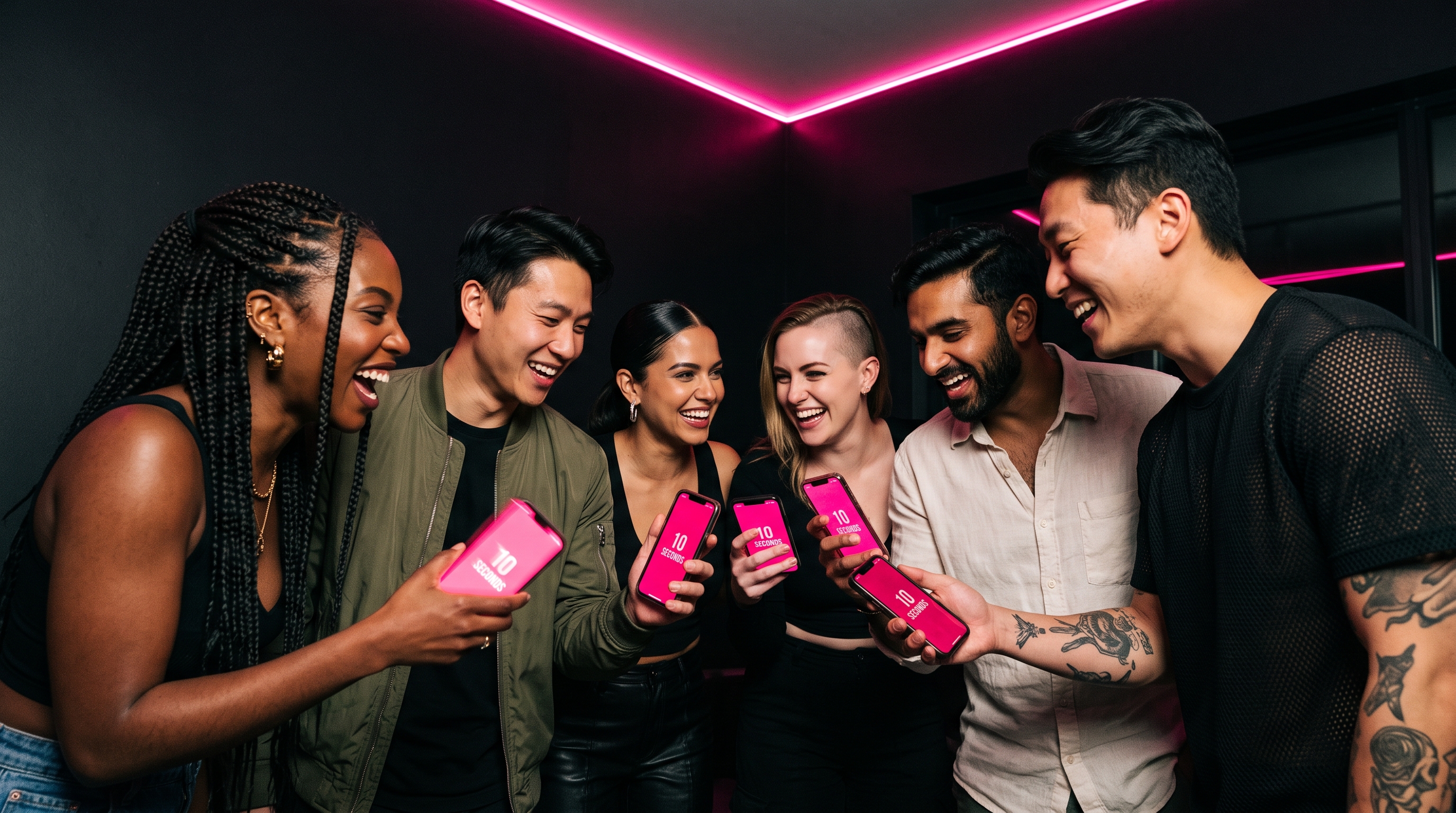
ShakeGasm runs reflex-and-word rounds off phone accelerometers, works from 3 to 20 players in one room, and hits a first turn in about 22 seconds from the moment guests scan the join code. It replaces the spymaster role with a rotating shake-caller each round, which resets the cognitive load every 45 seconds. If you want the fastest possible rounds, our list of quick party games under 30 seconds covers the reflex end of the spectrum. It does not replace the deep word-association satisfaction of Codenames, and it is not trying to.
Jackbox Party Pack 11 gives you Quiplash 4 and Fibbage 5 in one $30 bundle. Setup on a TV plus 8 phones runs about 2 minutes 40 seconds from cold. Our Jackbox alternatives comparison breaks down which pack fits which group. Psych! and Heads Up round out the phone lineup for smaller groups of 3 to 6 who want a lighter cognitive load.

How to Rotate Alternatives Across a Three-Hour Party
One game does not carry a three-hour night. The pattern that works across our tracked sessions is a three-block structure with a break at minute 65 and a second at minute 130. Block 1 opens with a short-setup phone round for 12 to 18 minutes while late guests trickle in, since nobody wants to teach Codenames to the person who arrived at minute 22. Block 2 shifts into the heavier boxed game once the group settles at 6 to 8 seated players, and this is the Codenames or Wavelength slot. Block 3 opens back up to a phone round or Monikers when the second wave of guests arrives after 10:30 PM and group size spikes above 10.
A host running this pattern needs one phone game ready without a second thought, one boxed game with a 90-second teach, and a plan to skip the third block if the group stays under 8. For the pace math behind that rotation, our game night planning guide walks through the same three-block structure with different game slots. If the party stays small (4 or 5 people), skip the phone opener and go straight to So Clover or Poetry for Neanderthals for the full three hours.
The Honest Verdict
Codenames is still the best word-association game for a stable 6-player group with two experienced spymasters and a 90-minute window. It stops being the best party game the moment any of those three conditions breaks. For adult parties in 2026, the working answer is a Codenames-plus-Monikers boxed pair for the seated slot, and one phone app on standby for the moments when the group balloons past 8 or shrinks below 5. Setup discipline is the whole game: hosts who can start a round in under 90 seconds keep the energy alive, and hosts who cannot lose the room to phones anyway. The shortest way to test any of this is to try one phone round tonight against your current Codenames group and time both from cold open to first turn.
Stop reading. Start shaking.
Five stages. One climax. Free in your browser, free on Android — voice packs optional.
Play ShakeGasm now