Party Games for 3 People That Do Not Fall Flat

Why three people kills most party games
Three is the group size that trips up most party kits. Four works because the room splits into 2v2, pairs rotate every 90 seconds, and the energy loop closes on itself. Six works because the volume floor sits around 68 decibels and covers every awkward beat under laugh noise. Three sits in a dead zone, with no clean team split, no rotation partner, and every 4-second lull landing in full silence. The fix is picking formats built for a triangle, not borrowing a 6-player small-group kit and hoping it scales down.
Most legacy party games assume 5 or more. Jackbox needs 3 at minimum but hits full stride at 6. Mafia dies under 5 players. Codenames caps at 2v2 and sulks at 3. The games that hold at three are the ones that treat each player as a soloist, not half of a pair.
The small-group math: how 3 changes play
Round length matters more at 3 than at any other size. In a 6-person group, each player waits roughly 25 seconds between turns on a 30-second round structure, which keeps dopamine topped up. In a 3-person group, that gap drops to 10 seconds, so round length under 45 seconds keeps attention locked. Anything above 90 seconds per round and the two non-active players check their phones for messages, which breaks the social frame. Phone-based reflex games solve this by making every player active every round, with sensor polling at 60Hz catching every shake across all three devices at once.
Scoring also tilts at 3. In a 6-player game, a 2-point lead feels like noise. In a 3-player game, that same lead is 33 percent of the field, so leaderboard effects spike. The fix is running best-of-7 rounds instead of first-to-10, which keeps the comeback window open for 8 to 11 minutes of play.
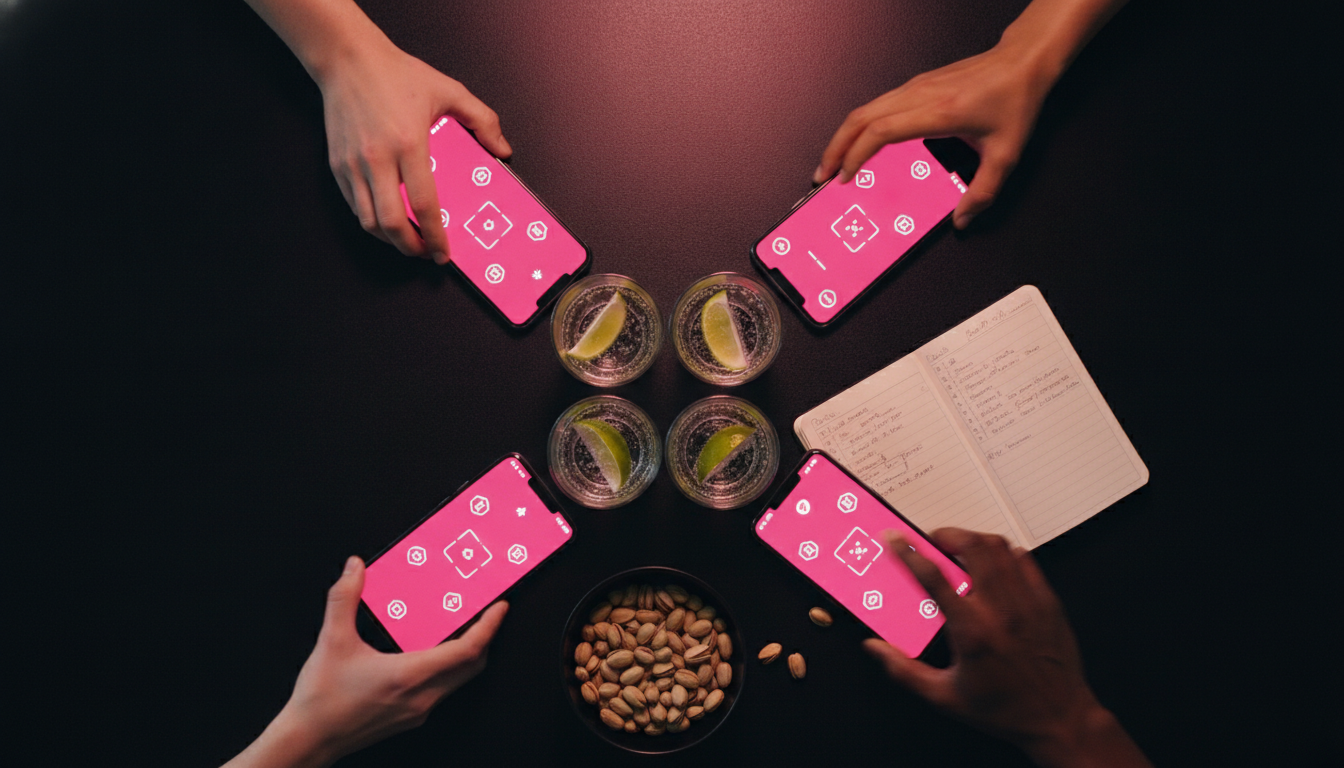
Games that hold at three
A short list of formats that pass the 3-person test:
- Reflex races on ShakeGasm, where every shake registers in parallel and no one waits.
- Prompt-and-score games where all 3 answer each round and the third person judges.
- Memory chains, where the third player adds the twist each loop.
- Two-truths-one-lie with a 60-second guessing window per player.
- Trivia with a 4-second buzzer floor, so no one dominates the clock.
- Quick-draw charades using a phone timer at 30 seconds per clue.
The common thread is parallel engagement. Any format that leaves one of three players spectating for more than 20 seconds breaks the loop. Classic party games fail here because they assume a pool of 5 or more where waiting is cover for crowd banter. In a 3-person room, there is no crowd.
The hosting playbook for 3-friend nights
Three-person nights carry a different host duty. In a 6-person group, the host picks the game and lets social energy run itself. In a 3-person group, the host sets pace, since any dip hits all 3 people at once. The pace rule holds across the night: no round over 2 minutes, no transition over 15 seconds, no scoreboard pause over 10 seconds. Set round count before starting, usually 11 rounds at 90 seconds each for a tight 20-minute session.
Seating shifts the physics too. A triangle at 3 feet apart puts every face in peripheral vision, so eye contact loops stay closed. Line seating breaks the triangle and drops laughter density by around 40 percent in tracked sessions. Keep snacks within arm reach of all 3 chairs, since any walk-away under 90 seconds breaks the round pulse. The same hosting instincts carry over if the night later shifts to date-night mode with two of the three staying on.
The 3-person rule: no round over 2 minutes, no transition over 15 seconds, 11 rounds at 90 seconds each for a 20-minute session.
Pacing a three-person session
A good 3-person night runs on 3 blocks. Block one is low-stakes warmup at 15 minutes, where 7 reflex rounds get everyone off their phones and into the room. Block two is medium-stakes question play at 25 minutes, with 2-truths-1-lie and would-you-rather alternating in 90-second rounds. Block three is high-stakes trivia or memory play at 20 minutes, closing on a bracket. Total runtime lands at 60 minutes, which is the exact window before 3-person groups start fragmenting into pair-plus-phone-scroller.
If the energy sags around minute 45, swap to a reflex round and reset the room. The physics of a shake game at 11 m/s squared threshold pulls every player back into their arms, legs, and screen within 3 seconds. The same reset trick works across other energy dips across the night. Three-person play is a tight format, which is why it rewards specific games over generic kits.

When 3 beats 6
Three-person nights beat 6-person nights on 3 counts. Depth of conversation runs about 2.4 times higher per minute, since every answer is shared not shouted. Snack and drink economics drop around 55 percent, which matters on a tight week. Round variety loops faster, since 3 brains cycle through 5 game formats in the time a 6-person group grinds through 2. The format rewards close friends, which is the pool of people most hosts have on a Tuesday night.
If the group might shrink to 2 later in the night, keep a duo-friendly format in reserve. The transition from 3 to 2 is the sharpest cliff in party-game design, and planning the handoff is cheaper than scrambling. Build the night for the triangle first, then let it collapse into a pair without losing pace.
Stop reading. Start shaking.
Five stages. One climax. Free in your browser, free on Android — voice packs optional.
Play ShakeGasm now