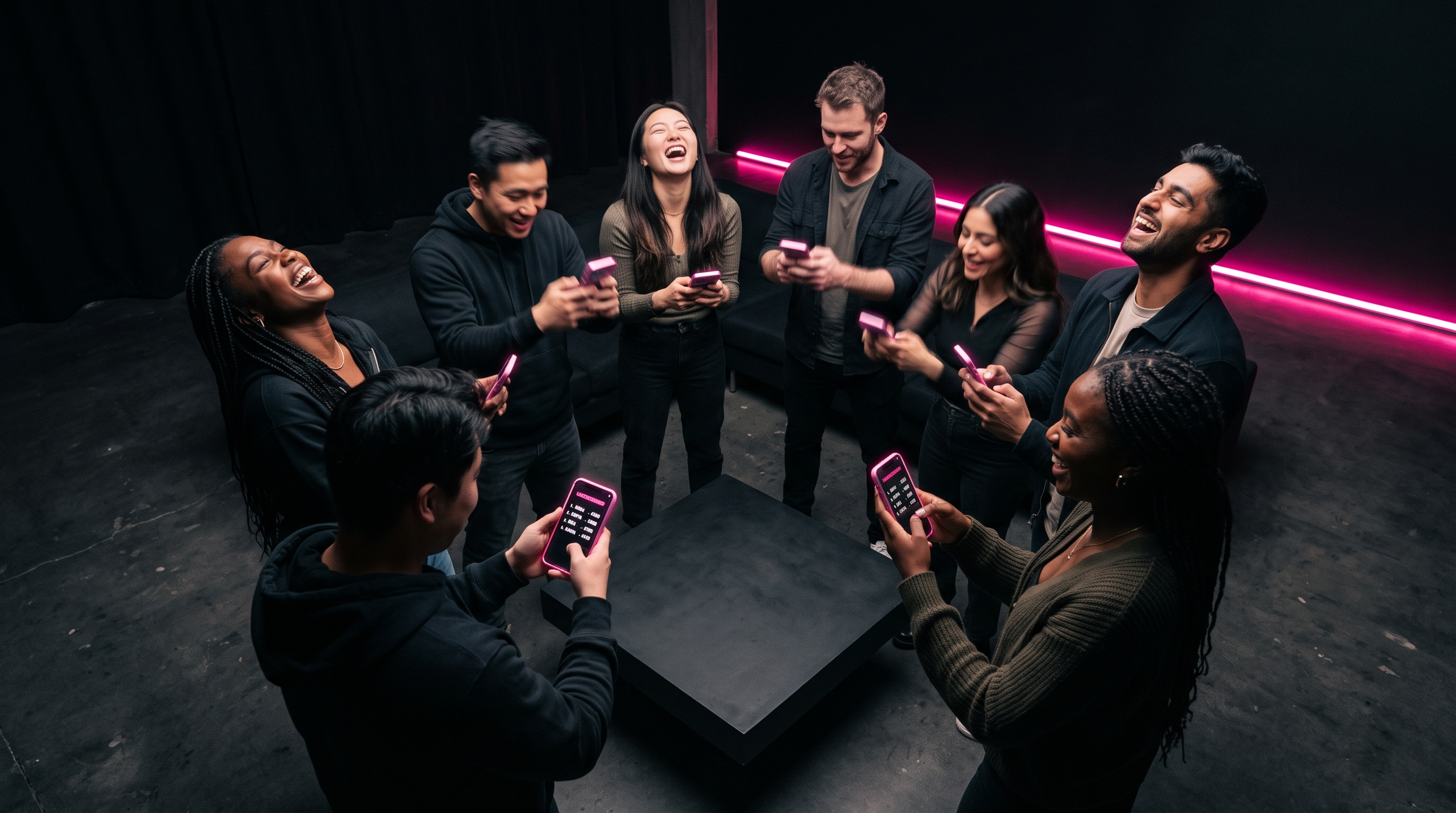
Party Games for Large Groups: 12 or More People

Twelve people in a room is the point where most party-game templates quietly stop working. Rounds that felt tight at six start running past ninety seconds, side conversations fracture the group, and the host loses the thread by the fifteenth prompt. Games built around one person at a time, a single scorekeeper, or a single device collapse under group math the moment the room crosses the dozen mark. The scaling cliff is sharpest between 12 and 20 players, where the format usually blames the guests instead of itself. A game that works for 20 looks structurally different from one that works for 6, and most hosts never notice the difference until the energy drops.
The fix is not loudness or louder music. It is picking formats that treat all 20 phones or all 20 bodies as part of one simultaneous loop. The best large-group formats share three traits: short rounds under 45 seconds, parallel input from every player, and team-level scoring that absorbs the people who are not naturally loud. The rest of this piece covers which games meet that bar, which fail silently, and how to run a three-hour window for 20-plus players without losing the room by the second hour. For a smaller cousin to this problem the 6 to 8 player bracket has its own fault lines, and for the opposite end the two-player evening breaks on completely different mechanics.
Why most party games break above 12
When a party game runs on sequential turns, group size multiplies waiting time. A 90-second round at 6 players equals 9 minutes per rotation and three or four rotations in an hour. At 20 players the same round length pushes a single rotation to 30 minutes, which means most guests get one or two turns the entire night. The remaining 28 minutes of each cycle is spent watching someone else perform. By turn six the back half of the room has drifted to the drinks table and the game is finished before the host wants it to be.
Attention has a hard ceiling that scales inversely with crowd size. Research on group dynamics puts the natural audience limit for a single-speaker format at about 7, after which side conversations become statistically inevitable. Any game that puts one person on the hot seat while 19 others listen has already lost 12 of those listeners within 20 seconds. Volume alone does not fix this because the fracture is structural, not acoustic. The games that survive at scale remove the solo-speaker format entirely.
Signs a game has outgrown your group:
- One rotation takes longer than 10 minutes.
- Fewer than half the players have spoken in the last 5 minutes.
- The scorekeeper is confused about whose turn it is.
- Side conversations last longer than game actions.
- The host is louder than the players.
The three mechanics that scale past 20
Simultaneous input is the single most important mechanic for large groups. Every player acts at the same moment, which means a 20-person round can finish in 15 seconds instead of 15 minutes. Reflex games built on accelerometer sensing, voice volume, or synchronized tapping all share this property, and they are the reason phone-based party apps have taken over the 12-plus bracket since 2023. ShakeGasm runs on this model, with everyone shaking at once and the whole room scoring in parallel, which keeps the active player count equal to the room count.
Team-level scoring is the second multiplier. Individual leaderboards punish quieter players and shrink the active base to the three or four extroverts. Splitting 20 people into four teams of five turns the dynamic inside out: the quieter players carry rounds for their team, the loud ones are checked by their teammates, and the scoreboard is a group fight rather than a personality contest. Teams of 4 to 6 are the sweet spot, with 7 and above drifting back into audience mode.
Short rounds are the third pillar. Any round longer than 45 seconds in a large group starts to feel like a presentation. Rounds between 20 and 40 seconds let you run 15 to 20 cycles in an hour, which keeps the dopamine loop tight and the group kinetic. Games that cannot be compressed into that window are not large-group games, no matter how good they are at six players.
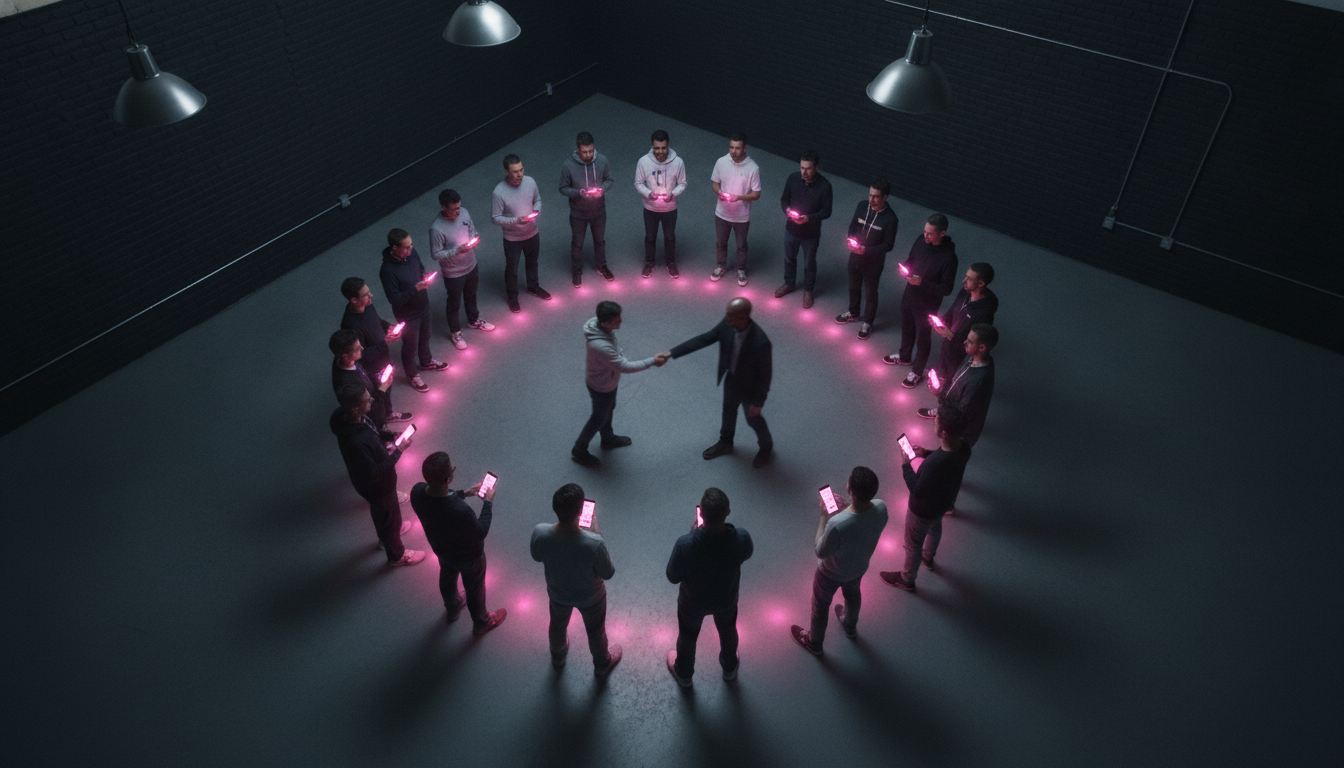
Phone-first games that hold a 20-person room
A handful of mobile party games are built from the ground up for 20 to 50 players. Numbered picks ranked by setup time:
- ShakeGasm (setup 60 seconds, round length 20 to 30 seconds, scales to 50 phones in one room). Players shake, hold still, or flip their phones on cue, with a shared screen leading the round. Simultaneous input and team mode both built in.
- Kahoot in party mode (setup 3 to 4 minutes, round length 20 seconds, scales to 100-plus). Trivia-first, which limits replay value, but the parallel-answer mechanic scales cleanly.
- Jackbox Quiplash (setup 2 minutes, round length 90 seconds, caps at 8 active plus unlimited audience). Audience mode is the only reason it holds a 20-person room; otherwise it caps hard at 8.
- Psych (setup 90 seconds, round length 60 seconds, scales to 16). Fake-answer bluffing that gets slower past 12 but can be split into two rooms.
- Heads Up team mode (setup 60 seconds, round length 60 seconds, scales to 20 in a team split). Phone passes from one teammate to the next, so the active player rotates fast.
The friction cliff hits between game three and game four. Jackbox and Psych are polished products but their round math caps them before 20 players, which is why they dominate the 8-player bracket and fall off above it. ShakeGasm and Kahoot are the only two in this list that genuinely scale past 30.
Analog games that still work when the group hits 30
Phones are not required. Werewolf and Mafia both scale to 25 with the right moderator because the entire group plays every round, the roles distribute attention evenly, and a single round takes 10 to 15 minutes with 20 active participants. The format fails only if the moderator cannot track role interactions, which is a solvable problem with a cheat sheet.
Pictionary in teams of 5 is another analog format that holds large rooms. Four teams of five means every team is drawing or guessing every round, nobody is sitting out, and a 60-second drawing window keeps the pace tight. Charades fails the same test because only one person is active at a time, which puts the format back in the 6-to-8 bracket. The split between what scales and what does not is almost always the simultaneous-input question, independent of whether a phone is involved.
The format that scales past 20 is the one where every guest is doing something in the same 30-second window. Everything else is an audience problem pretending to be a party game.
How to run a 20-plus-player session without losing the room
Three-hour windows are the realistic ceiling for a large-group game night, and the energy curve inside that window is predictable. The first 30 minutes is warmup and setup, the middle 90 minutes is the kinetic peak, and the final hour is the fade. Front-load the loud reflex games into the middle 90, run team-based rounds for the first and last 30 minutes, and switch formats every 25 to 30 minutes to prevent any single game from carrying the whole night.
A rotation that works reliably at 20 players: open with 20 minutes of Kahoot or trivia to lock the group in, shift to 40 minutes of ShakeGasm or another reflex format for peak energy, break for 15 minutes, run 30 minutes of Werewolf, then close with another 20-minute reflex round. Three games across three hours with a hard break at the halfway point. The break matters more at 20 players than at 6 because the recovery cost of a draining round is multiplied by the group size.
The host job also changes at 20. One moderator cannot track a 20-person room across four teams, so pick a co-host before the first round and give them scoreboard duty while the lead host runs the game flow. Two coordinated hosts beat one overworked host every time at this scale, and the drop-off in energy management between a solo host and a pair is sharper than most planners expect.
Stop reading. Start shaking.
Five stages. One climax. Free in your browser, free on Android — voice packs optional.
Play ShakeGasm now